
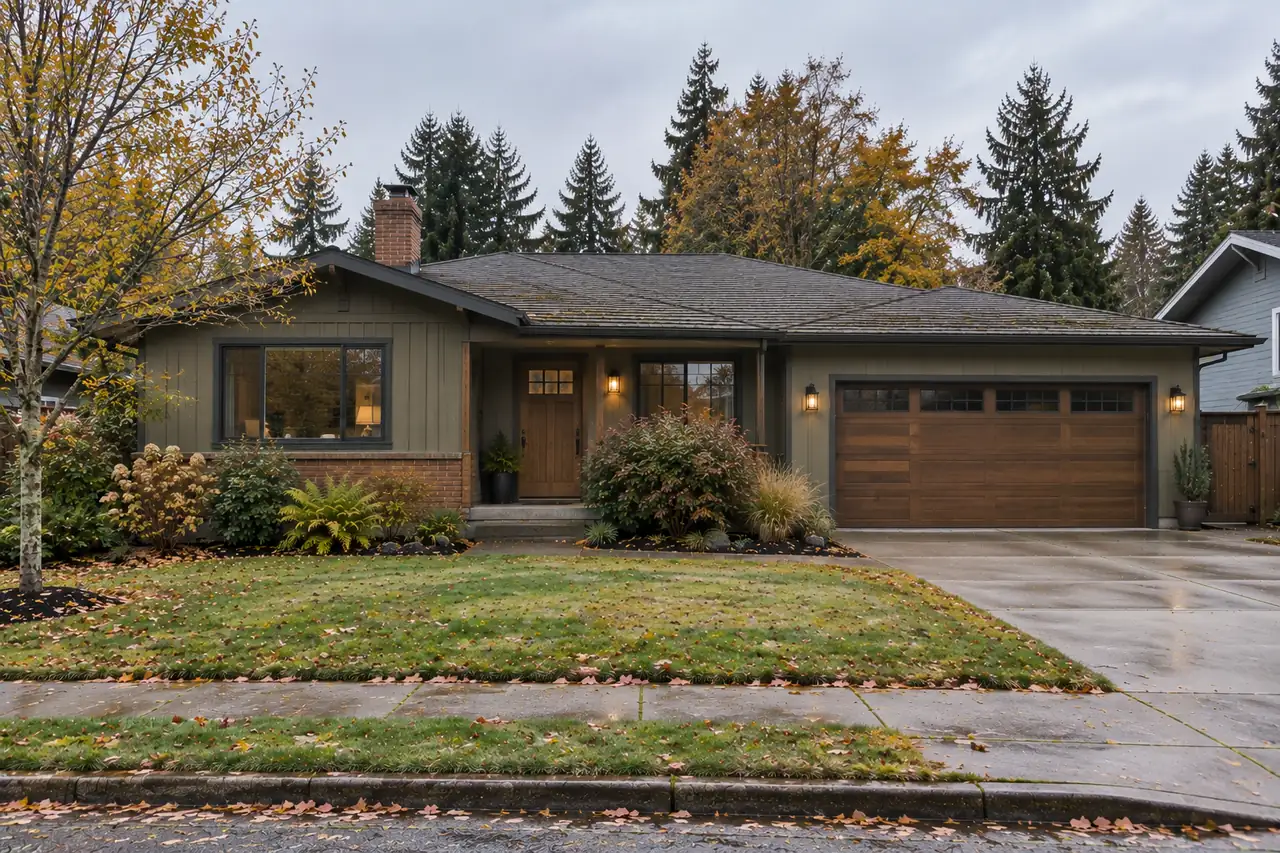
Siding Repair in Salem, Oregon: Fix It or Replace It?
Honest siding repair answers, before you pay for a full tear-off: what can be fixed a board at a time, what repairs are published to cost, and the signs that a wall needs more than a patch.
Siding repair fixes part of a wall rather than all of it: rotted or split boards, soft trim and window sills, a leak where a flashing failed, woodpecker holes, a cracked or loose vinyl panel. It makes sense when the damage is contained and the sheathing behind it is sound. In Salem, repairing siding does not need a building permit unless the wall must be fire-resistive, but repairing the sheathing does, and the city lists dry rot repair among work that always needs one. Tell us what you are seeing and we will follow up about a repair quote.
What does siding repair cover?
- Replacing damaged lap boards, sections of T1-11 panel siding, and cedar shingles or shakes
- Rebuilding rotted trim, window sills and corner boards
- Stopping leaks at kick-out flashing, window and door heads, and other flashing
- Patching or replacing boards with woodpecker holes
- Rehanging or replacing buckled, cracked or loose vinyl panels
- Priming, caulking and painting the repaired area
Repair or replace: start with where the water got in
Most siding damage is water damage, and the repair-or-replace question usually comes down to how far the water has travelled. A single failed detail, such as a roof edge with no kick-out or a window with no head flashing, soaks the boards below it and nothing else. Fix the detail, replace the wet wood, and the wall is done. When the same failure repeats on every side of the house, or the wood behind the siding has gone soft, patching one spot leaves the others still getting wet.
The repair-or-replace table further down this page sets out the common findings one by one, with the rule or manufacturer’s instruction behind each. Two lines in it matter more than the rest in Salem:
- The sheathing. Siding work alone is exempt from a City of Salem building permit unless the wall must be fire-resistive. Repairing or replacing the sheathing behind it is not exempt, so a repair that finds rotted sheathing becomes permitted work. The city’s permit page also lists dry rot repair among work that always needs a permit; Salem’s siding permit rules sets the two city pages side by side.
- The drainage gap. Oregon’s residential code wants a drainage space of at least 1/8 inch behind siding by default, but it exempts repairs where new siding matches the existing siding in the same plane, over a sound water-resistive barrier. A matching repair can go straight back on. A full re-side builds the gap in.
If the table points toward replacement, siding replacement covers the whole job, and the best siding for Salem’s climate compares what could go on instead. On houses built in the 1980s and 1990s, swelling hardboard or OSB siding is the textbook case for replacing rather than repairing: the boards that have not failed yet are the same product as the ones that have.
How much does siding repair cost?
HomeGuide’s national range for siding repair is $2 to $14 per sq ft of repaired wall. It is a national figure, and HomeGuide puts the spread down to the material, how far the damage goes and where the house is. Worked out from that range, and not a quote:
- A 4-by-8-foot area of damaged wall, 32 square feet, comes to $64 to $448.
- A 10-by-8-foot stretch under a failed roof edge, 80 square feet, comes to $160 to $1,120.
Rotted sheathing is priced once the wall is open, and in Salem it adds a permit and an inspection. Paint, lead-safe work on an older house, and matching an out-of-production profile add to a repair too.
For comparison, the published figures for a whole-house re-side are job totals, not rates. The Remodeling 2025 Cost vs. Value Report (www.costvsvalue.com) puts the Pacific-region average for replacing 1,250 square feet of siding at $22,555 with fiber cement and $18,507 with vinyl, trim included. HomeGuide notes that removing the old siding is often left out of first estimates; its national range for removal and disposal is $70 to $200 per square (100 sq ft of wall).
Sources for the figures in this section: Remodeling 2025 Cost vs. Value Report (www.costvsvalue.com). © 2025 Zonda Media, a Delaware Corporation. Complete data from the Remodeling 2025 Cost vs. Value Report can be downloaded free at www.costvsvalue.com. Checked September 16, 2026. The HomeGuide ranges are listed in the table on this page with their dates.
Why does water get behind siding?
Water rarely soaks straight through the face of sound siding. It gets in at a detail:
- A missing kick-out flashing at the foot of a roof-to-wall joint, where a lower roof dies into a wall. Oregon’s residential code requires one at every wall and roof intersection (section R703.4).
- Windows and doors with no head flashing, or with caulk that has cracked open.
- A torn or missing water-resistive barrier behind the siding, the layer section R703.2 requires over the whole wall.
- Siding too close to soil, mulch, decks or roofs, where it stays wet through the winter.
Each of those details is described in what goes behind siding in Oregon, from how house wrap is lapped to where Z-flashing belongs. Replacing the rotted boards without fixing the detail that let the water in usually means doing the repair twice. A good repair quote names the cause and says how the fix deals with it.
Damage from a storm or a falling limb is a different case: it starts on the outside, and it may be an insurance claim. Storm damage and insurance claims in Oregon covers documenting it and what policies usually say.
Fascia and soffit repairs
The fascia, the board along the roof edge that the gutter usually hangs from, and the soffit, the underside of the eave, are wood trim, and they rot for the same reason siding does. The Forest Products Laboratory’s Wood Handbook calls roof edges critical points for decay and recommends gutters and downspouts kept free of debris, and a National Park Service preservation brief shows a cracked gutter that let water rot the fascia boards behind it. A new fascia board under a gutter that still overflows will rot again, so ask what the quote does about the water source. Gutters are usually a separate trade, so the repair may cover the wood and leave the gutter to someone else. Trim, soffits and fascia covers what a contractor checks, including keeping the soffit vents open, and rotted fascia and soffit boards has a walk-around checklist and the gutter, roofing and lead questions.
How do contractors find hidden rot?
By probing the wood, reading it with a moisture meter, and pulling a board or two where the damage looks worst so the sheathing can be seen. A home inspector does none of this, because Oregon’s inspection standards are visual; siding issues on a home inspection explains what a report can and cannot tell you. If the sheathing is sound, the job stays a board-level repair. If it is soft, the repair becomes wall work, and in Salem that needs a building permit. Dry rot repair in Salem covers what to look for before anyone arrives and what the city’s permit pages say about rot, and what causes dry rot explains why the wood has to stay wet for it to start.
Can a contractor match your existing siding?
Often, but it depends on the product:
- Fiber cement lap siding comes in standard profiles and exposures, so a cracked board can usually be swapped on its own.
- Wood lap siding can be bought or milled to an existing profile, though new wood looks different until it is primed and painted.
- Hardboard and OSB lap siding from the 1980s and 1990s is the hardest to match. Options include boards salvaged from a less visible wall, or re-siding a whole wall between corners so old and new never sit side by side.
- Vinyl panels lock into each other, so one panel can be unlocked and replaced, but vinyl fades, and a new panel can look different beside weathered ones in the same color name.
- Cedar shingles and shakes can be woven into existing courses; new wood stands out until it weathers or is finished.
Oregon’s code expects the same: repair work uses like materials, or materials the code allows for new construction, and ordinary repairs need no application to the building official (section R105.2.2). On a Salem historic property, ordinary repair and painting do not need historic design review either, but replacing siding with a different type, style or material does. Matching what is there keeps a repair on the right side of both lines.
A siding repair, before and after
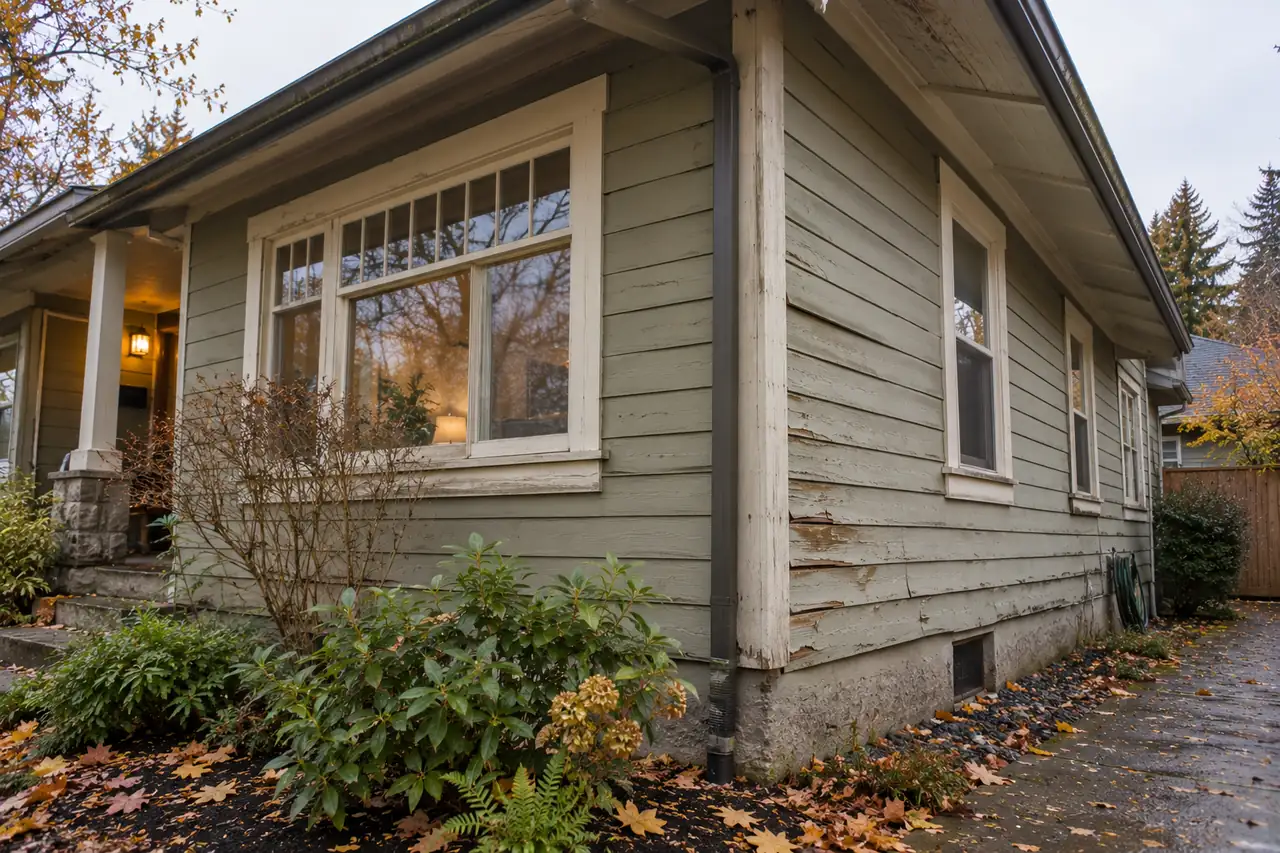
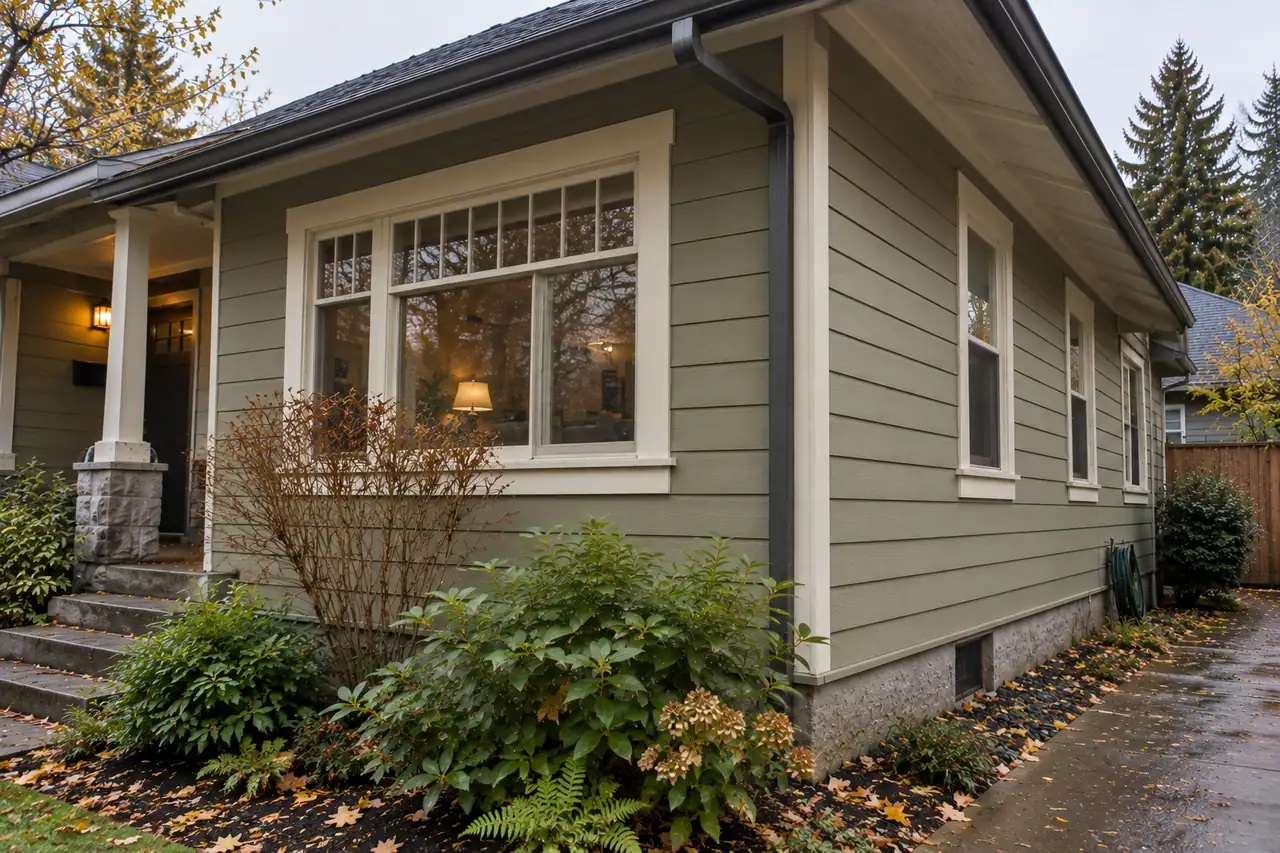
Painting after a siding repair
New boards and cut ends need primer before paint, or the paint on them tends to fail first. Paint also has application limits: Sherwin-Williams lists a minimum of 35°F and a surface at least 5°F above the dew point for its Duration exterior paint. In Salem, the dry months from June through September are the easiest time to finish a repair; a winter repair may need its final coat later. If the rest of the wall looks tired too, deciding whether to repaint or replace siding starts with the condition of the boards.
Repairs on houses built before 1978
Older paint may contain lead. In Oregon, a contractor whose work disturbs 20 square feet or more of painted exterior on a pre-1978 home needs a Construction Contractors Board lead-based paint renovation license and has to work lead-safe. Ask about it when you describe the job, particularly in Silverton, where the median home was built in 1978 (Census ACS 2020-2024).
Request a siding quote and describe the damage in a sentence or two. We will follow up about the quote.
Request a Siding Quote
Describe the siding project once. Requesting a quote is free, with no obligation.
Damage signs: repair or replace
| Attribute | Usually a repair when | Price a replacement when | The rule behind it |
|---|---|---|---|
| Soft or rotted boards and trim | The rot stops at a few boards and the sheathing behind them is firm when probed | The sheathing is soft in more than one place, or rot turns up on several walls | Salem exempts siding work from a building permit unless the wall must be fire-resistive, but requires one to repair or replace sheathing, and its permit page lists dry rot repair among work that always needs one |
| Stains or rot below a roof edge or window | One detail failed, such as a missing kick-out or an unflashed window head, and the wet wood is local | Barrier or flashing is missing or torn wall after wall | Oregon's code requires flashing at every window and door opening, plus a kick-out at each wall and roof intersection (R703.4) |
| Swollen hardboard or OSB lap boards | The swelling is on one wall and sound boards can be found to match | Lower edges are swelling on several walls, since every board on the house is the same product | Both class-action settlements closed years ago, so repairs are at the owner's cost |
| A buckled, cracked or loose vinyl panel | Panels were nailed tight or one was hit: rehang it loose or swap the panel | Replacement panels cannot match a whole faded wall and the owner wants one color | The installation manual calls for nail heads left about 1/32 inch off the panel |
| A cracked or broken fiber cement board | One or two boards, swapped individually | The same clearance or flashing mistake repeats around the house | James Hardie's Technical Bulletin 17 says face nails added to blind nails may be appropriate for a repair; its instructions set clearances to grade and roofing |
| Woodpecker holes | A few holes in sound wood: patch or replace the boards | Soft wood around clusters of holes on several walls | Woodpeckers are on the federal list of birds protected under the Migratory Bird Treaty Act |
| New boards next to old ones | Matching siding goes back in the same plane over a sound barrier | The whole wall is re-sided, so the drainage gap applies | R703.1.1 wants a 1/8-inch drainage space behind siding by default, with an exception for matching repairs |
Signs it is time to call someone
Boards, trim or window sills feel soft, crumble when probed, or have split and darkened.
Wood rots where water keeps coming back: failed caulk and paint, trim with no drip cap, boards set too close to soil or a roof. Once rot reaches the sheathing behind the siding, the repair becomes wall work, and the City of Salem lists dry rot repair among work that needs a building permit, so confirm the scope with the city first.
Stains, bubbling paint or soft spots below a roof edge, or under windows and doors.
Water behind siding usually gets in where a lower roof edge meets a wall with no kickout flashing, through a torn or missing water-resistive barrier, or around windows that were never properly flashed. Oregon's residential code calls for kickout flashing at those roof-and-wall intersections.
Grooved plywood panels are peeling apart, swollen or soft along the bottom edge.
T1-11 is grooved plywood, and it fails from the edges in: the cut bottom edge near the ground, horizontal seams with no Z-flashing, and the corners of windows. Where the panels are also the wall's structural sheathing, the City of Salem requires a building permit to replace them.
Paint blisters and peels on the same wood boards, even after repainting.
Paint that keeps failing on the same boards is usually being pushed off by moisture from behind, or went over cut ends and replacement boards that were never primed. Repainting without fixing that source usually peels again.
Round holes, alone or in rows, in cedar or other wood siding and trim.
Woodpecker holes let rain into the wall, so damaged boards or shingles are patched or replaced rather than just caulked. Woodpeckers are protected under federal law, so the answer is repair and deterrence, not harming the birds.
Vinyl panels look wavy, have buckled or cracked, or have slipped out of their trim.
Vinyl expands and contracts with temperature, so it has to hang loosely on its nails with a gap at every corner post and channel. Panels nailed tight or cut without those gaps can buckle, strong reflected sunlight can distort them, and impacts crack them.
Published repair and removal ranges
National ranges from HomeGuide, per unit of wall, each with the date it was checked. The whole-house replacement figures above are quoted in the text rather than listed here, because their source allows them only in running text.
| Work | Typical range | Basis | Source |
|---|---|---|---|
| Siding repairThe guide puts the variation down to material, extent of damage and location. | $2 - $14 | per sq ft of repaired wall | HomeGuide, "How Much Does It Cost to Repair Siding?" (updated February 9, 2026). National figures.checked September 16, 2026 |
| Old siding removal and disposalCheck that a replacement quote includes it; the guide notes it is often left out of first estimates. | $70 - $200 | per square (100 sq ft of wall) | HomeGuide, "How Much Does House Siding Cost to Install or Replace?" (updated October 29, 2025): $0.70 to $2.00 per sq ft, national.checked September 16, 2026 |
Prices on this page are general ranges gathered from published sources, not a quote. What a job actually costs depends on the specifics of the job and who does the work. Only a quote from a qualified siding contractor who has seen the job is a real price. Last reviewed September 16, 2026.
How it works
Describe the siding project
Answer a few questions: the ZIP code of the house, what is wrong with the siding or what you want done, and your timing. It is free.
We follow up
We follow up by phone or email about your siding project and the quote.
The siding is seen and quoted
A firm price comes after the walls have been looked at in person, because rot or soft sheathing behind the boards changes the job and the price.
You decide
Check the CCB license number on the quote at search.ccb.state.or.us, compare it, and go ahead only if it is right for you. You are under no obligation.
Common questions
How much does siding repair cost in Salem?
No Salem-specific figure is published. HomeGuide's national range is $2 to $14 per sq ft of repaired wall, and it puts the spread down to material, extent of damage and location. A repair that uncovers rotted sheathing costs more than the siding alone and, in Salem, needs a building permit.
How much siding can be repaired before replacement makes more sense?
There is no fixed percentage. Repair works while the damage is contained and the boards can be matched. Once rot or swelling shows up on several walls, or the sheathing is soft in more than one place, ask for a full replacement to be priced alongside the repair so the two can be compared.
Does a repaired section need the drainage gap that new siding gets?
Not when it is a like-for-like repair. Section R703.1.1 of the 2023 Oregon Residential Specialty Code requires a drainage space behind siding by default, but exempts repairs and alterations where the new siding matches the existing siding in the same plane over a code-compliant water-resistive barrier. A full re-side does not fit that exception.
Does repairing rotted sheathing need a permit in Salem?
Yes. The City of Salem's permit guidance exempts siding repair on its own, unless the wall must be fire-resistive, but says a building permit is required when the sheathing underneath is repaired or replaced. The city's permit page also lists dry rot repair among work that always needs a permit, so ask the city about any rot repair before it starts.
Can woodpecker holes in siding just be filled?
Small holes in otherwise sound wood can be patched. Boards with many holes, or soft wood around them, are better replaced so rain cannot get into the wall. Woodpeckers are protected under the Migratory Bird Treaty Act, so the fix is repair and deterrence, not harming the birds.
Request a Siding Quote
Describe the siding project once. Requesting a quote is free, with no obligation.
Learn more
Related services
Siding Replacement
A full tear-off and re-side: old cladding off, rotted sheathing repaired, then a new water-resistive barrier, flashing, trim and siding.
Cedar & Wood Siding
Cedar lap siding, sawn shingles and split shakes: board-by-board repair, matching older profiles, and full replacement.
Vinyl Siding
Vinyl lap, board-and-batten and shake-style siding, plus repair of panels that have buckled, cracked or pulled loose.