
Yes. In Oregon a certified home inspector must observe and describe the wall cladding, flashing and trim, plus the eaves, soffits and fascias, and say in writing whether each is satisfactory. The inspection is visual, so a siding line in the report points to what water may be doing behind the boards. It does not prove it.
This guide reads the report the way Oregon’s rules write it: what the inspector has to look at and what they may skip, which siding findings matter most on houses around Salem, what a “pest and dry rot” report is, what the seller’s disclosure asks, and what to do while the clock runs.
In short:
- Oregon’s standards of practice require an inspector to describe the siding, flashing, trim, eaves, soffits and fascias, and to recommend what to do about each problem.
- The inspection is visual. The inspector does not have to remove siding, move plants or soil, explain the cause of a problem or price the fix.
- The siding findings that matter most are the ones that suggest water behind the boards: soft wood, swollen board edges, missing kick-out flashing, and siding too close to the ground or a roof.
- A pest and dry rot (wood-destroying organism) exam is separate from a standard home inspection unless the contract includes it.
- The company that inspected the house may not bid on repairing it for 12 months.
What does an Oregon home inspector check on siding?
Home inspection in Oregon runs through the Construction Contractors Board. Under ORS 701.445, a person may not work as a home inspector unless the board has certified them and they own or work for a business the board licenses. The CCB’s home inspection consumer notice explains how to check both: get the business’s CCB license number and the inspector’s certification (OCHI) number, then look them up on the CCB’s license search.
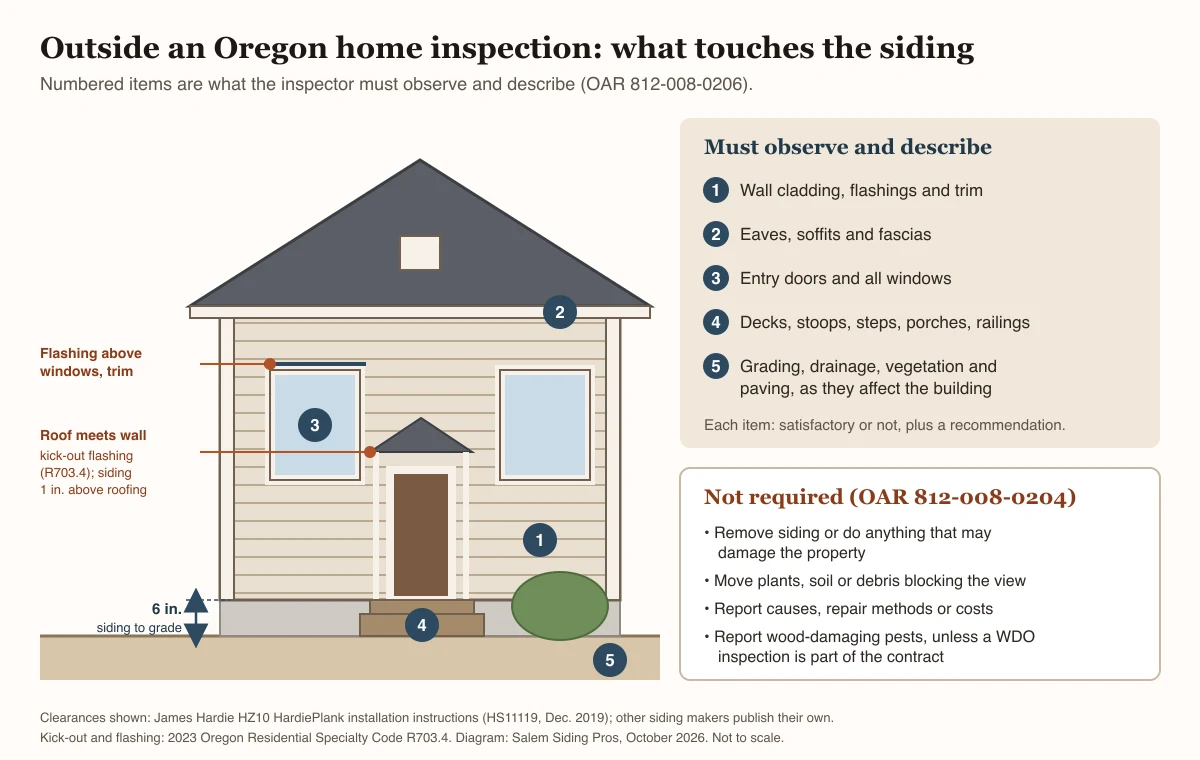
The board’s standards of practice set out the outside of the house. Rule OAR 812-008-0206 says the inspector shall observe and describe:
- wall cladding, flashings and trim
- entryway doors and all windows
- attached decks, balconies, stoops, steps, porches and their railings
- eaves, soffits and fascias
- vegetation, grading, drainage, driveways, patios, walkways and retaining walls, as far as they affect the condition of the building
Roofing is its own category in the next rule, OAR 812-008-0207, and it includes roof flashings and signs of leaks. The two meet at every roof-to-wall corner, where Oregon’s code requires a kick-out flashing to turn water away from the siding.
The report rule, OAR 812-008-0202, is stricter than many buyers expect. The report has to record each listed item and say whether it was satisfactory; a list of deficiencies alone does not meet the rule. For each problem it has to state whether something does not function as intended, how habitability is affected, if at all, and a recommendation to “monitor, evaluate, repair, replace” or take other action. It also has to carry the business’s CCB license number and the inspector’s certification number.
What the inspection leaves out
The same rules set the limits. OAR 812-008-0203 calls the inspection visual and not technically exhaustive. Under OAR 812-008-0204, the inspector does not have to report on:
- the causes of the need for a repair
- the methods, materials and costs of corrections
- the life expectancy of any component
- compliance with codes
- pests such as wood-damaging organisms
Nor does the inspector have to do anything that may damage the property, or move plant life, soil or debris that blocks the view. A shrub against the wall or a stack of firewood can hide the lowest courses of siding, the ones James Hardie’s instructions keep 6 inches above the ground. If the report says an area was obstructed, that area was not inspected.
Which siding findings are the real red flags?
Oregon’s rules do not rank findings or define a “major” defect. What they require is a statement of whether each component works as intended and how, if at all, the problem affects habitability. For siding, the findings that deserve the most attention are the ones that suggest water is getting behind the boards, because Oregon’s code treats siding as only the outer layer of the wall. The 2023 Oregon Residential Specialty Code requires a water-resistive barrier behind it (section R703.2) and flashing at openings, at projecting trim and where roofs meet walls (R703.4).
| What the report may describe | Why it matters | What usually comes next |
|---|---|---|
| Soft, deteriorated or decayed wood at trim, sills or the lowest boards | Decay needs wood that stays wet, and it can spread to the sheathing behind the siding | A contractor probes the wood and opens a test area; see dry rot repair in Salem |
| Swollen, flaking or uneven bottom edges on pressed-board (hardboard) siding | The Forest Products Laboratory links lasting edge swell in hardboard to paint failure, more water uptake at the edges and decay | Board replacement or a re-side; see hardboard siding |
| Delaminating or soft T1-11 panels, often along the bottom edge | On some houses the same plywood panels also brace the wall | Confirm what is behind the panels before anyone quotes; see T1-11 siding |
| No kick-out flashing where a lower roof meets a wall | Section R703.4 requires kick-outs at all wall and roof intersections | Flashing work plus a look at the wall below |
| Siding touching soil, mulch, a path or a roof | James Hardie’s HZ10 instructions call for 6 inches to finished grade, 1 inch above paths, steps and decks, and 1 inch above roofing | Regrading, trimming the siding, or both |
| Gaps, failed caulk or no flashing above windows, doors and trim | Section R703.4 requires flashing at window and door openings and continuously above projecting wood trim | Flashing and trim repair |
| Cracked, loose or wavy vinyl panels | Panels can usually be replaced one at a time if a match is found | Panel repair; see vinyl siding |
| Cement-board siding or shingles on an older house | Some contain asbestos; Oregon requires a survey before most renovation of homes built before 2004 | A test before any quote; see asbestos siding in Oregon |
The decay row follows the Forest Products Laboratory’s Wood Handbook, which says serious decay happens only when wood is wetted above the fiber saturation point, by rain, condensation or wet ground, and that wood kept air dry will not decay. The hardboard row is from the laboratory’s review of thickness swell in hardboard siding (FPL-GTR-96), prepared for the Department of Housing and Urban Development. The clearances are from James Hardie’s HardiePlank HZ10 installation instructions, the zone its ZIP list assigns to Salem; vinyl, LP and cedar makers publish their own. The asbestos rule is the Department of Environmental Quality’s homeowner fact sheet.
Two of those rows come up often on houses here because of when they were built. The Census Bureau’s American Community Survey (2020-2024, table B25034) puts about half of Salem’s homes before 1980 and about a quarter in the 1980s and 1990s. Hardboard siding and LP’s OSB siding from those years were the subject of national class-action settlements, which the Washington Post reported in 1997 (reprinted by The Seattle Times). If the report names either product, a question on the seller’s disclosure applies too; see below.
How serious is dry rot found during a home inspection?
It depends on how far it reaches, and a visual inspection cannot tell. Rot confined to a trim board or a few siding boards is a board-level repair. Rot that has reached the sheathing or framing is wall work. The City of Salem’s building permit page lists “dry rot repair” among work that always needs a permit (read from the 2026-03-10 archived copy, because the city’s site blocks automated reading); siding permits in Salem sets that line beside the city’s exemption for siding-only work.
Finding the edge of the damage takes tools the inspector is not asked to use: a probe, a moisture meter and a board or two pulled where it looks worst. Siding repair describes how that check works and when a repair turns into a re-side.
Time matters more here than in a dry climate. NOAA’s 1991-2020 normals for Salem McNary average 40.08 inches of precipitation a year, with measurable rain or snow on about 148 days, and on 15.7 to 18.9 days in every month from November through April. Wood that a leak keeps wet through that season stays wet for months. What causes dry rot explains the moisture levels decay needs.
Is dry rot covered by homeowners insurance?
Usually not. Oregon’s Division of Financial Regulation says that policies generally exclude damage caused by seepage, dry rot or pests, because those problems usually come from poor maintenance rather than a sudden and accidental event. Sudden damage from wind, a falling limb or ice is a different case, covered in storm damage and insurance claims in Oregon.
What is a pest and dry rot inspection in Oregon?
The phrase comes from Oregon’s sale paperwork. The seller’s property disclosure set out in ORS 105.464 asks whether a “pest and dry rot, structural or whole house inspection” has been done within the last three years. In the rules for home inspectors, the pest part is called a wood destroying organism (WDO) inspection, and it is separate from the standard inspection:
- The rule defining “inspect” for home inspectors, OAR 812-002-0360, leaves out exams for wood-destroying organisms except when they are part of an inspection for the transfer of real estate.
- The inspection contract must state conspicuously whether a WDO inspection is included and whether one is available for a fee (OAR 812-008-0202).
- A standard home inspection is not required to report on wood-damaging organisms at all (OAR 812-008-0204).
Treating wood-destroying pests is regulated separately again. Using pesticides against termites, carpenter ants and powderpost beetles in or around buildings is its own license category, Structural Pest, at the Oregon Department of Agriculture.
In practice, read the inspection contract for the WDO line. If a separate pest and dry rot report was ordered, ask who wrote it and which license or certification they hold, and keep it with the home inspection report: a contractor quoting the siding will want both.
What Oregon’s seller disclosure asks about siding
Under ORS 105.465, the seller of a one-to-four-unit home, among other property types and with some exceptions, must complete and deliver the disclosure statement to each buyer who makes a written offer. Several questions on the statutory form bear on siding:
- Roof leaks. Has the roof leaked, and has it been repaired?
- Remodeling. Have there been additions, conversions or remodeling, and if so, was a building permit required, obtained and given a final inspection?
- Inspections. Has a pest and dry rot, structural or whole house inspection been done in the last three years?
- Moisture. Are there moisture problems, areas of water penetration, mildew odors or other moisture conditions? A yes calls for an explanation of the frequency and extent of the problem and any insurance claims, repairs or remediation.
- Recalled or litigated materials. Was any construction material the subject of a recall, class action, settlement or litigation? The form follows up with whether there are problems, a warranty, an inspection, past claims, money received, and repairs or replacement.
- Insulation. Is there insulation in the exterior walls?
The statute also gives the buyer a window. Under ORS 105.475, unless the buyer has waived it in writing, a buyer has five business days after the disclosure is delivered to revoke the offer by a separate signed, written statement. That is the text of the law, not legal advice; how it applies to a particular offer is a question for your agent or a lawyer.
For a seller, paperwork answers these questions better than memory: invoices for past siding work, permits and final inspections, and any earlier inspection reports.
What buyers and sellers do next
Which options are open depends on the purchase agreement, so start with your agent. In general terms they are to ask the seller to repair before closing, to ask for a credit or a price change, to ask for time for a specialist’s opinion, or to accept the house as it is. Whatever the choice, a written scope from a siding contractor that answers the report line by line gives both sides something concrete to discuss.
Three Oregon rules shape who writes that scope and what it must include:
- Not the inspector. Under ORS 701.450, a business that provides home inspection services may not bid on or undertake repairs to a structure its owner or employee inspected, for 12 months after the inspection.
- Not someone else’s report. The CCB’s consumer notice says a buyer may not use or rely on an inspection report the seller ordered, and OAR 812-008-0202 requires every report to say so in capital letters on its first page. A buyer relying on a seller’s pre-listing report has no report of their own.
- The usual rules still apply on a deadline. Replacing or repairing siding that is not required to be fire-resistance rated is exempt from a permit under section R105.2 of the 2026 Oregon Residential Specialty Code, but the exemption does not authorize work that breaks the code, and sheathing or dry rot repair in Salem needs a permit. On a house built before 2004, DEQ requires an asbestos survey by an accredited inspector before renovation, with an exception for owner-occupants doing their own renovation work inside their home. On a house built before 1978, the Oregon Health Authority’s lead-safe renovation rule exempts owners working on their own home and minor repairs that disturb less than 20 square feet of exterior paint; contractors doing covered work need the CCB’s Lead-Based Paint Renovation license.
What a siding repair quote should answer
A quote written against an inspection report is easier to compare, and easier to hand to the other side of the sale, when it answers these points:
- Which report items it covers, using the report’s own numbering or wording.
- The water source, not only the boards. If the report mentions a missing kick-out, flashing above trim or siding too close to the ground, the quote should say how that is fixed. House wrap, flashing and rainscreen rules in Oregon explains what those details are.
- Hidden damage. Sheathing or framing found once boards come off can only be priced then, so ask how the quote handles it, such as a unit price per sheet or an allowance.
- Permits. Whether one applies, and who applies for it.
- Older-house rules. For a house built before 2004, whether the siding has been tested for asbestos; for one built before 1978, lead-safe work practices and the contractor’s lead-based paint renovation license.
- The contractor’s CCB license number, checked on the CCB’s search. Oregon’s rules for written contracts and required notices are set out in what a siding replacement contract should include.
- Timing. A start date that works with the closing date, and what happens if weather delays exterior work.
If you have a report in hand, describe the siding findings on the quote form; it asks whether you own the house, and “I am buying it” is one of the answers. For what a board-level repair involves and where it turns into a re-side, see siding repair in Salem.
This page is general information, not professional advice about your specific situation. Have it assessed by a qualified professional before making decisions. Last reviewed October 26, 2026.