
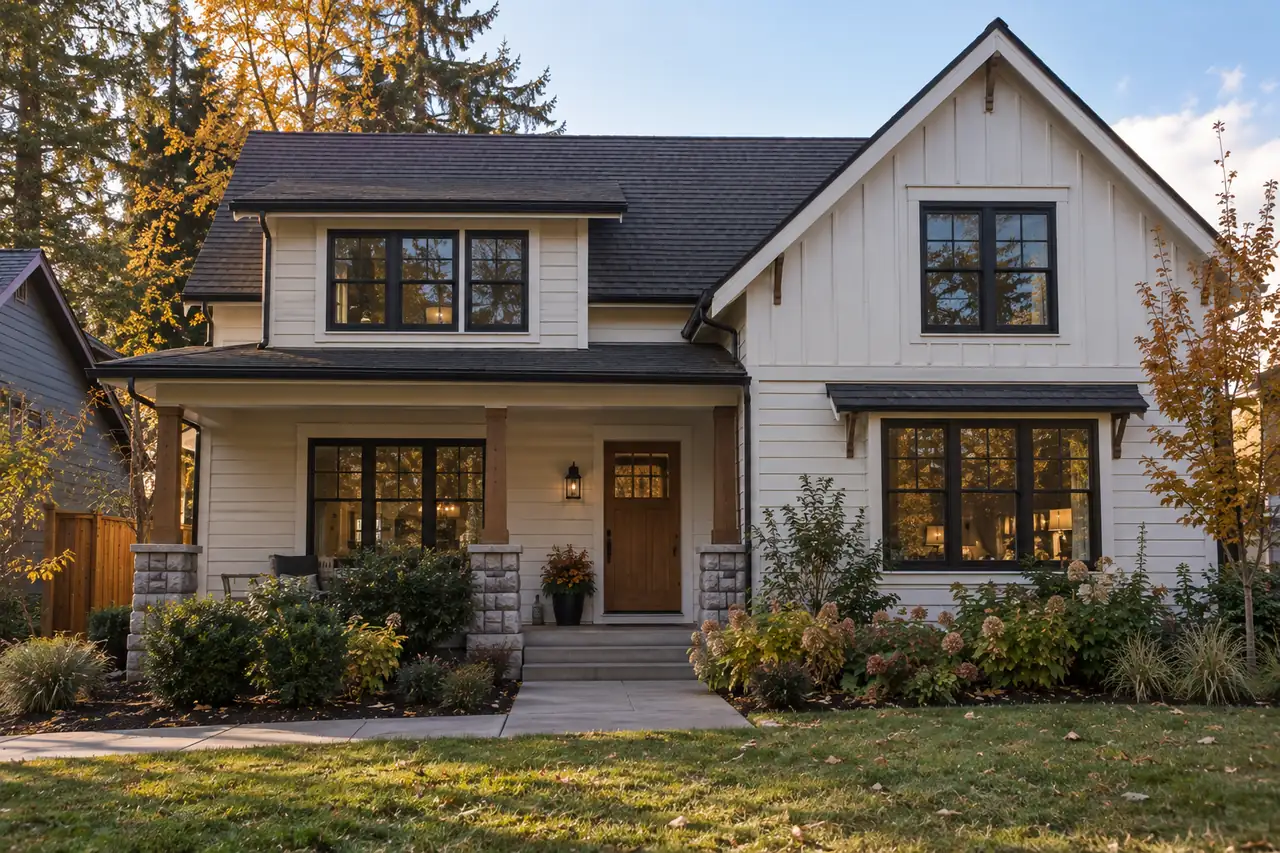
James Hardie Fiber Cement Siding in Salem, Oregon
Lap boards, panels and shingles from James Hardie, Allura and other makers. The install details that decide how well fiber cement lasts, and what the published figures say it costs next to vinyl.
Fiber cement siding combines cement, sand and cellulose fiber, pressed into lap boards, vertical panels and shingles. James Hardie and Allura are two of the companies that make it. Homeowners also call it Hardie board, HardiePlank (James Hardie’s lap siding), cement board or fiber cement board; James Hardie’s own name is Hardie siding. Most of what decides how a fiber cement wall performs is in the installation: clearances, joints, flashing and paint, each set out in the maker’s instructions. Describe your house and we will follow up about a fiber cement quote. Salem Siding Pros is not affiliated with any siding manufacturer.
Which James Hardie instructions apply in Salem?
James Hardie divides the country into climate zones and makes two product lines: HZ5 for zones 1 through 5, and HZ10 for zones 6 through 10. Its ZIP code list and its online zone finder both place Salem’s ZIP codes in HZ10, while Bend, east of the Cascades, is in HZ5. The two versions of the HardiePlank instructions differ in places, most visibly on roof, deck and path clearances, so it is worth asking a contractor which version they install to. For Salem the answer should be HZ10.
Other makers publish their own manuals. Allura’s installation manual sets 6 inches to the ground and 1 to 2 inches to the roof, and gives primed boards the same 180-day painting window as James Hardie.
Lap, panel, shingle: fiber cement profiles
Fiber cement comes in the same looks as the wood siding it often replaces. James Hardie’s installation guide and product pages describe these lines:
- Lap siding (HardiePlank). Factory-primed boards in 12-foot lengths, with nominal widths from 5 1/4 to 12 inches, in textures such as Select Cedarmill, smooth and beaded.
- Vertical panels (HardiePanel). Factory-primed sheets in 4-by-8, 4-by-9 and 4-by-10-foot sizes, in smooth, stucco, Cedarmill and Sierra 8 textures. Panels are also one of the options for replacing T1-11.
- Board and batten. Not a separate product: James Hardie says its trim battens “are intended to be used with HardiePanel vertical siding to achieve a board and batten look.”
- Shingles (HardieShingle). Sold mainly as straight-edge or staggered-edge panels 48 inches long by 16 inches high, with individual shingles for smaller areas.
- Trim and soffit. HardieTrim boards, which James Hardie describes as decorative, non-load-bearing trim, and HardieSoffit panels, vented or non-vented, for the underside of the eaves.
Allura’s product range covers lap siding, vertical panels, shakes that come as panels, trim and soffit. Mixing profiles on one house, such as lap on the walls and shingles in the gables, means following each product’s own instructions where they meet.
Install details that decide how fiber cement lasts
The table further down this page sets James Hardie’s HZ10 figures beside Oregon’s code. For the order a whole job runs in, from tear-off to the final inspection, see siding replacement in Salem, step by step. For fiber cement itself, four groups of details carry most of the weight:
- Clearances. Six inches of clearance to finished grade, with the soil sloping away from the house, keeps the lowest course up off wet ground through a Salem winter. The instructions also leave at least 1 inch above roofing, decks, paths and steps, and 1/4 inch above horizontal flashing.
- Flashing. Oregon’s code requires a kick-out flashing at every wall and roof intersection, and James Hardie’s own kick-out detail shows one at least 4 by 4 inches. Z-flashing goes where a deck ledger meets the wall and above horizontal trim.
- Joints and caulk. Boards meet in moderate contact at butt joints, backed by joint flashing, which James Hardie recommends over caulk or an H-jointer. Its best practice guide leaves a 1/8-inch gap where siding meets trim, filled with flexible sealant. Its Technical Bulletin 9 says not to caulk the horizontal overlap between planks, and the gap above horizontal flashing stays open too: water has to be able to drain out. The same rules for vinyl, LP and cedar sit side by side in where to caulk siding and where not to.
- Paint. Factory-primed boards must be painted within 180 days of installation, with 100 percent acrylic topcoats recommended, and never while the siding is wet. James Hardie rules out stain and oil or alkyd paint on its products. Every field-cut edge is caulked, primed or painted, and prefinished ColorPlus boards are touched up only with the maker’s own kits.
Behind all of it, the wall follows Oregon’s code: a continuous water-resistive barrier (R703.2), and by default a drainage space of at least 1/8 inch behind the siding (R703.1.1). Those are 2023 Oregon Residential Specialty Code sections; a 2026 edition took effect on October 1, 2026, with a six-month phase-in to April 1, 2027.
Cutting fiber cement: silica dust
Cutting fiber cement releases respirable crystalline silica. OSHA’s silica standard for construction lists the controls for handheld saws cutting fiber-cement board with a blade of 8 inches or less: outdoors only, with a saw fitted with a commercially available dust collection system that has a filter of 99 percent efficiency or better. James Hardie’s instructions add that its products should never be cut with a power saw indoors, and that dust should be vacuumed or wetted, not dry-swept. Expect a cutting station set up outdoors, placed so the airflow carries dust away from people nearby.
Primed or prefinished boards?
Primed boards go up without color and are painted on site, which leaves a free choice of paint but puts the 180-day window and the paint’s own temperature and dew-point limits on the schedule. In Salem, the dry months from June through September make those easiest to meet.
Prefinished boards, such as James Hardie’s ColorPlus line, arrive painted. There is less painting on site, but color choices are limited to the maker’s range, cut edges are sealed with the maker’s edge coaters, and nicks larger than a dime are replaced rather than touched up, according to James Hardie’s best practice guide. Repainting either kind later, and what that means for the ColorPlus finish warranty, is covered under painting Hardie siding.
Replacing hardboard, OSB or T1-11 with fiber cement
Fiber cement is one of the materials quoted when swelling hardboard or OSB siding or damaged T1-11 has to come off. The tear-off is when the real scope shows up:
- Rotted sheathing is repaired before the new siding goes on, and in Salem that repair needs a building permit; see Salem’s siding permit rules.
- T1-11 that was also the structural sheathing needs a City of Salem building permit to replace, because taking it off removes part of the wall’s structure, not just its covering.
- Style is a choice. Fiber cement lap boards can replace lap hardboard, and vertical fiber cement panels, such as James Hardie’s HardiePanel, keep a panel look like T1-11’s.
Is fiber cement a good fit for Salem’s weather?
Salem’s weather mostly asks siding to shed winter rain: roughly six to seven inches a month from November through January, according to NOAA’s 1991-2020 normals. Fiber cement copes with that as long as the barrier, flashing and drainage space behind it are built properly and its clearances are respected. It does not soften in heat, which matters in a city that reached 117°F on June 28, 2021, and a board cracked by a falling limb in an ice storm can be replaced on its own.
On fire, James Hardie says its siding complies with ASTM E136 as a noncombustible cladding, and notes that this does not extend to the paint on it. After Senate Bill 83 repealed Oregon’s statewide wildfire hazard map in 2025, no state rule requires fiber cement; that choice is yours.
Fiber cement or vinyl: what the published figures say
The site’s figures for both materials are whole-job averages for replacing 1,250 square feet of siding, trim included:
- Pacific region, 2025: fiber cement $22,555, vinyl $18,507, in the Remodeling 2025 Cost vs. Value Report (www.costvsvalue.com).
- Albany, Oregon, 2024: fiber cement $17,948, vinyl $19,172, in the Remodeling 2024 Cost vs. Value Report (www.costvsvalue.com). Albany, about 25 miles south, is the report’s closest market to Salem.
So fiber cement costs more than vinyl in the regional averages and less in Albany’s. For how the two, and engineered wood and cedar, cope with rain, heat and ice-storm limbs, see fiber cement, vinyl, LP and cedar compared for Salem’s climate. Neither average is a quote, and the report does not explain individual market results. Removing the old siding can be a separate line, and HomeGuide notes it is often left out of first estimates; its national range for removal and disposal is $70 to $200 per square (100 sq ft of wall).
Sources: Remodeling 2025 Cost vs. Value Report (www.costvsvalue.com). © 2025 Zonda Media, a Delaware Corporation. Complete data from the Remodeling 2025 Cost vs. Value Report can be downloaded free at www.costvsvalue.com. Remodeling 2024 Cost vs. Value Report (www.costvsvalue.com). © 2024 Zonda Media, a Delaware Corporation. Complete data from the Remodeling 2024 Cost vs. Value Report can be downloaded free at www.costvsvalue.com. Checked September 16, 2026. Removal: HomeGuide, "How Much Does House Siding Cost to Install or Replace?" (updated October 29, 2025): $0.70 to $2.00 per sq ft, national. Checked September 16, 2026. These are published averages, not a quote; what else moves the price is set out on the siding cost page.
Request a siding quote and choose fiber cement siding, or “Not sure yet” if you are still weighing materials. We will follow up about the quote.
Request a Siding Quote
Describe the siding project once. Requesting a quote is free, with no obligation.
James Hardie instructions vs Oregon code
| Attribute | James Hardie HZ10 instructions | Oregon's residential code |
|---|---|---|
| Clearance to finished grade | 6 inches, with the ground sloping away from the house | No separate figure for fiber cement; siding goes on to the maker's instructions (R703.3) |
| Clearance above a roof | At least 1 inch between roofing and siding (2 inches in the colder-zone HZ5 version) | A kick-out flashing at every wall and roof intersection (R703.4) |
| Decks, paths and steps | At least 1 inch, with Z-flashing where a deck meets the wall | Flashing where a deck or porch attaches to the wall (R703.4) |
| Over horizontal flashing | At least 1/4 inch, left uncaulked | Flashing continuous above projecting wood trim (R703.4) |
| Lap between courses | At least 1 1/4 inches, face or blind nailed | At least 1 1/4 inches (R703.10.2) |
| Butt joints | Boards in moderate contact over joint flashing (preferred), caulk or an H-jointer | Ends caulked, covered with an H-section joint cover, or over a strip of flashing (R703.10.2) |
| Caulking | A 1/8-inch gap at trim, filled with flexible sealant; the laps between boards are not caulked | No figure |
| Paint | Primed boards painted within 180 days of installation, 100 percent acrylic topcoat, not when wet; no stain or oil-based paint | No figure |
Signs it is time to call someone
Lap boards have swollen, mushroomed or gone soft at the lower edges, and paint will not stay on.
Hardboard (often called Masonite) and LP Inner-Seal OSB siding are wood-fiber products that soak up water through unsealed edges and nail holes, then swell and lose strength. Both were common on houses built in the 1980s and 1990s, and both class-action settlements closed to claims years ago.
Grooved plywood panels are peeling apart, swollen or soft along the bottom edge.
T1-11 is grooved plywood, and it fails from the edges in: the cut bottom edge near the ground, horizontal seams with no Z-flashing, and the corners of windows. Where the panels are also the wall's structural sheathing, the City of Salem requires a building permit to replace them.
How it works
Describe the siding project
Answer a few questions: the ZIP code of the house, what is wrong with the siding or what you want done, and your timing. It is free.
We follow up
We follow up by phone or email about your siding project and the quote.
The siding is seen and quoted
A firm price comes after the walls have been looked at in person, because rot or soft sheathing behind the boards changes the job and the price.
You decide
Check the CCB license number on the quote at search.ccb.state.or.us, compare it, and go ahead only if it is right for you. You are under no obligation.
Common questions
Is James Hardie siding the same thing as fiber cement?
James Hardie is a brand; fiber cement is the material. Allura and other companies also make fiber cement siding, and each maker publishes its own installation instructions, which are the ones a contractor should follow.
Which James Hardie installation instructions apply in Salem?
James Hardie splits the country into climate zones and makes two product lines, HZ5 and HZ10. Its ZIP code list and online zone finder both put Salem's ZIP codes in HZ10, so the HZ10 installation instructions are the ones that apply. Bend, east of the Cascades, is in HZ5.
How much clearance does fiber cement siding need?
James Hardie's HZ10 instructions show 6 inches between its siding and the finished grade and at least 1 inch between roofing and siding, and 1 inch above decks, paths and steps. Allura's manual asks for 6 inches to the ground and 1 to 2 inches to the roof. Each maker's own figures are the ones to follow.
How soon does primed fiber cement have to be painted?
James Hardie says its factory-primed products must be painted within 180 days of installation, and Allura gives the same 180-day window for its primed products. James Hardie recommends 100 percent acrylic topcoats and says not to paint wet siding or use stain or oil-based paint.
Is fiber cement cheaper or more expensive than vinyl near Salem?
It depends which published figures you read. In the Remodeling 2025 Cost vs. Value Report (www.costvsvalue.com) Pacific-region averages, replacing 1,250 square feet of siding came to $22,555 with fiber cement and $18,507 with vinyl. In the 2024 figures for Albany, Oregon, it was $17,948 and $19,172: fiber cement below vinyl.
Request a Siding Quote
Describe the siding project once. Requesting a quote is free, with no obligation.
Learn more
Related services
Siding Replacement
A full tear-off and re-side: old cladding off, rotted sheathing repaired, then a new water-resistive barrier, flashing, trim and siding.
Vinyl Siding
Vinyl lap, board-and-batten and shake-style siding, plus repair of panels that have buckled, cracked or pulled loose.
Cedar & Wood Siding
Cedar lap siding, sawn shingles and split shakes: board-by-board repair, matching older profiles, and full replacement.